Shopify merchants are not installing more apps than before. They are installing different ones. Over the last 90 days, interest moved away from marketing and store design tools and toward apps that run the day-to-day business: shipping, delivery dates, sourcing products and blocking fraud.
The Orichi Research Team tracked every active app on the Shopify App Store from 23 July to 21 October 2026. Here is what changed, which niches are growing fastest, and what it means if you are choosing apps for your store.
The numbers at a glance
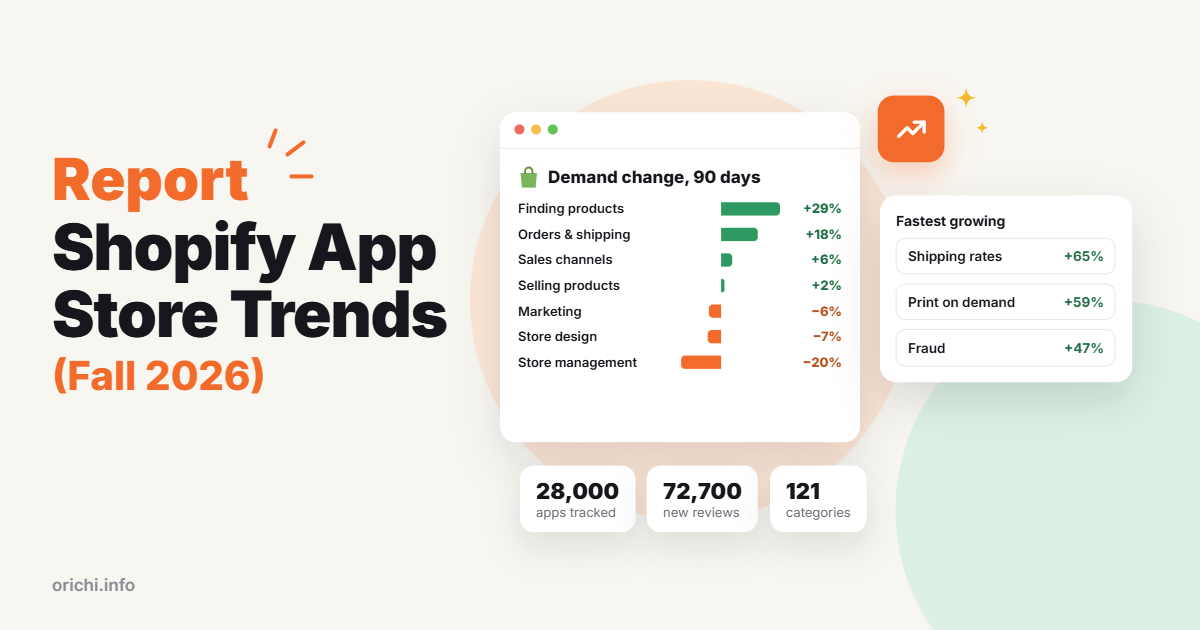
- 28,000 active apps on the Shopify App Store.
- 72,700 new reviews in the last 90 days, down 2% from the 90 days before.
- 12,000 new apps launched in the last 180 days. Only about 2,000 of them have received even one review.
- 121 app categories analyzed.
We use new reviews as a stand-in for new installs, because Shopify does not publish install numbers. More on that in the methodology section below.
Overall demand is flat
Across the whole App Store, new reviews stayed roughly level, with monthly totals moving up and down but no steady climb. These figures leave out a one-off event on 4 September 2026, when Shopify recounted reviews and about 39,000 were added to 4,000 apps in a single day.
New reviews per month across the Shopify App Store. October 2026 covers 1–20 October only. Shopify’s 4 September recount is removed.
Flat demand means the app market is no longer growing on its own. When one app gains users, it is usually taking them from another. For merchants, that means more choice and more aggressive offers. For app makers, it means competing on search ranking, listings and reviews, not just features.
Demand is shifting toward running the store
The clearest trend is a move from “grow and decorate” to “run and deliver.” Here is how Shopify’s main category groups performed:
| Category group | New reviews (90 days) | Change | Active apps | Apps launched in last 180 days |
|---|---|---|---|---|
| Finding products | 3.6k | +29% | 442 | 189 |
| Orders & shipping | 8.0k | +18% | 5.4k | 2.0k |
| Sales channels | 5.3k | +6% | 1.3k | 482 |
| Selling products | 9.1k | +2% | 1.8k | 742 |
| Marketing & conversion | 24k | -6% | 6.5k | 2.5k |
| Store design | 12k | -7% | 7.1k | 3.0k |
| Store management | 9.8k | -20% | 5.6k | 2.8k |
Marketing and conversion is still the biggest group by far, but it is shrinking. The fastest growth is in finding products (dropshipping and print-on-demand) and orders and shipping. Merchants seem to be spending less on getting traffic and more on fulfilling orders well.
A flood of new apps, but few get used
Since May 2026, between 1,500 and 2,800 new apps have launched on the Shopify App Store every month. Before that, the usual number was around 600. Much of this jump comes from AI tools that make it fast and cheap to build simple apps.
Light bars show all new apps launched each month. Dark bars show the ones that have received at least one review. October 2026 covers 1–20 October only, so its apps have had little time to collect reviews.
Most of these apps never find users. Only about 15% of recent launches have received a single review. Some developers have launched dozens of apps in a year with almost nothing to show for it. One developer released 90 new apps in 12 months; together they collected 2 reviews in 90 days. At least ten other developers each launched 20 or more apps with zero or one review between them.
What this means:
- Simple tools are now easy to copy. A basic popup, badge or button app has dozens of near-identical rivals.
- Reviews matter more than ever. In a crowded list, merchants lean on reviews and ratings to tell real products from throwaway ones.
- A brand-new app is not automatically a risk, but check it. Look for an active developer, a support page and recent reviews before installing.
The niches growing fastest
Several small niches grew quickly because a rule or a platform changed, creating a new need almost overnight.
- Estimated delivery dates. Shoppers want to know when an order will arrive before they pay. The delivery and pickup category grew 43%, and its leading app gained 191 reviews in 90 days. If your product pages don’t show an arrival date yet, Madgic Estimated Delivery Date by Orichi adds one.
- EU withdrawal button. Since 19 June 2026, online stores selling to EU consumers must offer a clearly labelled “withdraw from contract here” function for the whole withdrawal period (Directive (EU) 2023/2673). Two apps launched in 2026 for this gained 87 and 80 reviews in 90 days. Because the need comes from a regulation, demand may level off once most EU-facing stores comply. Orichi’s Madgic EU Withdrawal Button covers this requirement.
- AI search visibility (AEO / AI SEO). Merchants want their products to show up in answers from ChatGPT, Claude and other AI assistants. One AEO app launched in June 2026 gained 245 reviews in about four months. An llms.txt file is one simple step: it gives AI tools a clean summary of your store. LLMs.txt AI SEO for ChatGPT by Orichi creates one for you.
- Fraud and bot blocking. Up 47%, with 53% of new demand going to apps less than two years old. Merchants want to stop fake orders and bot visits that skew their ad data. Antifraud: IP Country Blocker by Orichi blocks traffic from countries and IP addresses you choose.
- Cart drawers and in-cart offers. Slide-out carts with progress bars and upsells are popular, and newer apps win 45% of the demand in this category. One cart drawer launched in June 2026 gained 62 reviews. Madgic Cart Drawer by Orichi is our take on it.
Top 10 categories by opportunity
We scored each category from 0 to 100 using five signals: how much demand it has, how fast that demand is growing, whether new apps can win users, how many merchants leave 1–2 star reviews, and how crowded the category is.
| Category | Score | New reviews (90 days) | Change | Share held by top 3 apps | Share going to apps under 2 years old | Median price (per month) |
|---|---|---|---|---|---|---|
| Dropshipping | 75 | 3.0k | +34% | 43% | 6% | $20.00 |
| Inventory sync | 73 | 1.7k | +43% | 20% | 8% | $19.00 |
| Chat | 73 | 1.9k | -2% | 19% | 49% | $20.00 |
| Shipping rates | 73 | 1.4k | +65% | 34% | 22% | $9.99 |
| Product variants | 71 | 4.0k | +29% | 33% | 16% | $9.95 |
| Delivery and pickup | 71 | 1.8k | +43% | 28% | 26% | $9.80 |
| Print on demand | 70 | 1.9k | +59% | 60% | 5% | $25.00 |
| Fraud | 69 | 1.1k | +47% | 58% | 53% | $10.00 |
| Abandoned cart | 69 | 905 | +27% | 22% | 33% | $17.99 |
| Upsell and cross-sell | 68 | 7.3k | -6% | 25% | 28% | $11.49 |
Two patterns stand out. Shipping rates grew fastest (+65%), and chat is the most open category: no app dominates, and almost half of demand goes to newer apps.
Each bubble is an app category. Further right means demand grew faster over the last 90 days. Higher up means more of that demand went to apps launched in the last two years. Bigger bubbles had more new reviews. Darker bubbles are categories where Orichi has an app.
The busiest corner is the lower left: large, established categories where demand is flat or falling and long-standing apps keep most users. The categories worth watching sit to the right, where demand is growing, and higher up, where newer apps can still win.
Rising stars: apps launched in the last 12 months
| Type of app | New reviews (90 days) | Launched |
|---|---|---|
| Barcode label generator | +303 | Oct 2025 |
| AI search (AEO) optimizer | +245 | Jun 2026 |
| Store locator and maps | +96 | May 2026 |
| EU withdrawal button | +87 | Mar 2026 |
| EU withdrawal button and form | +80 | Jan 2026 |
| AI sales and AEO assistant | +66 | May 2026 |
| Cart drawer with upsells | +62 | Jun 2026 |
| Subscriptions and bundles | +61 | Mar 2026 |
| Mobile app builder | +58 | Apr 2026 |
| Parcel locker delivery | +57 | Jun 2026 |
All ten are rated 4.8 stars or higher. Three of them answer the trends above: AI search, the EU withdrawal rule and cart drawers.
At the top of the whole store, the biggest apps keep growing. Shopify’s own Flow and Shop apps led with about 2,500 and 1,600 new reviews in 90 days, ahead of large bundle, subscription and product review apps.
What this means for your store
- Review your operations apps first. Other merchants are investing in delivery dates, shipping rates and fraud blocking. If your store still lacks these, they are likely to make a bigger difference than another marketing popup.
- Check new legal requirements. If you sell to EU shoppers, your store has needed a clear online withdrawal button since 19 June 2026. Check that yours is in place.
- Get ready for AI search. More shoppers now ask AI assistants what to buy. Clean product data, and tools like an llms.txt file, help those assistants understand your store.
- Choose apps by proof, not by launch date. With thousands of near-identical apps, look at reviews from the last few months, how fast support replies, and how often the app is updated.
- Keep your app list lean. Fewer apps mean a faster store, fewer conflicts and fewer things that can go wrong at checkout.
How we collected this data
The Orichi Research Team crawls the public Shopify App Store listing for every active app. This report covers the 90 days from 23 July to 21 October 2026 and compares them with the 90 days before.
Shopify does not publish install numbers, so we use new reviews as a stand-in. Apps that gain more users usually gain more reviews too, but the match is not exact: some apps ask for reviews more actively than others. We removed Shopify’s review recount of 4 September 2026 and smoothed one-off spikes for single apps, so they do not distort the trends.
Frequently asked questions
Which Shopify app categories are growing fastest in 2026? Shipping rates (+65%), print on demand (+59%), fraud (+47%), inventory sync and delivery and pickup (both +43%) grew fastest over the last 90 days.
Is the Shopify App Store still growing? The number of apps is growing fast, but merchant demand is flat. New reviews fell about 2% compared with the previous 90 days.
Why do so many new Shopify apps have no reviews? AI tools have made it easy to launch simple apps in large numbers. Only about 15% of recent launches have earned a review, because most offer nothing different from apps already on the store.
What is AEO, and why are merchants installing AEO apps? AEO (answer engine optimization) means making your store easy for AI assistants like ChatGPT to find and recommend. Merchants install these apps to appear in AI-generated shopping answers, not just in Google results.
Do Shopify stores need an EU withdrawal button? Yes, if they sell to consumers in the EU. Since 19 June 2026, EU rules require a clearly labelled online function that lets shoppers withdraw from a purchase during the withdrawal period, plus a confirmation step and an acknowledgement sent to the shopper.