Choosing the wrong white label Shopify partner costs agencies more than just money — it costs client relationships. This article profiles every major player in the market, explains exactly where each one excels and where they fall short, and tells you which partner fits which type of agency. No filler. No generic rankings. Just the information you need to make a confident decision.
Not all Shopify agencies are built the same. Some have genuine Shopify Plus expertise and the headless development depth to handle enterprise clients. Others are optimised for speed and cost — ideal for agencies whose clients need clean, functional stores delivered in three to five weeks. A handful are narrow specialists: one is better than anyone else at SEO-first international builds, another at conversion rate optimisation, another at B2B and ERP integrations.
The problem is that from the outside, most of these agencies present themselves identically. ‘Certified Shopify experts.’ ‘Full-service development.’ ‘White label friendly.’ The surface-level marketing language tells you almost nothing about whether a given partner can actually handle your typical project — or whether their delivery process is structured in a way that protects your client relationships and your agency’s brand.
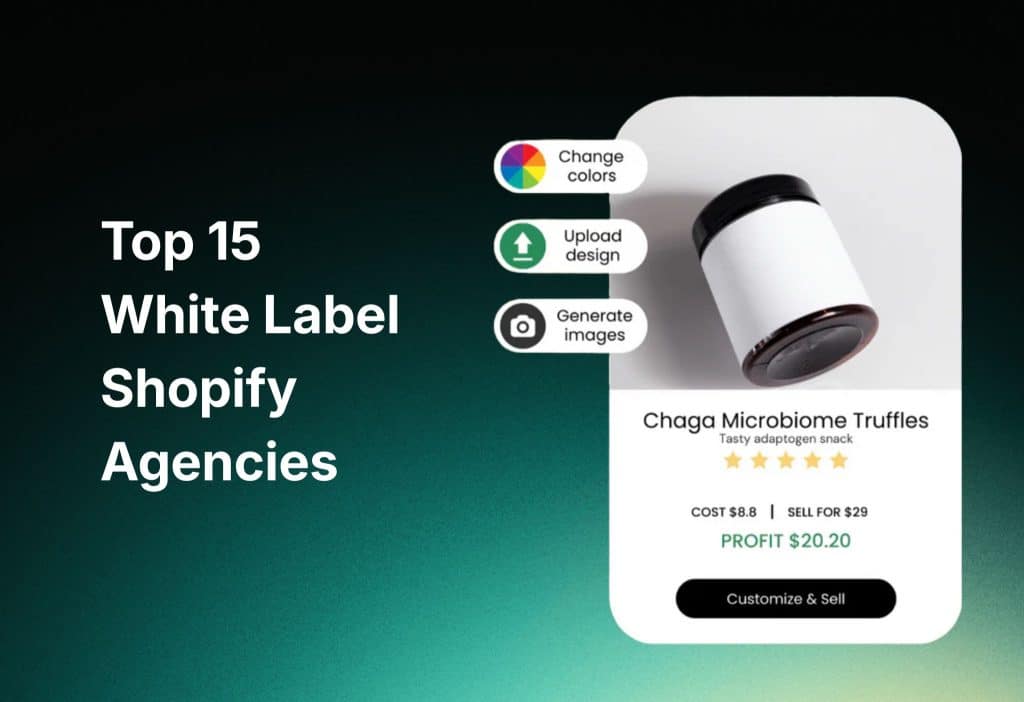
This article cuts through that. What follows is a profile of fifteen of the most consistently recommended white label Shopify agencies globally, examined through the lens of what agency owners actually need to know: real pricing ranges, genuine capability boundaries, honest turnaround expectations, and the type of agency each partner serves best.
We have also included a direct comparison table for quick reference, but the profiles are where the real differentiation lives. A table can tell you that two agencies cost roughly the same. Only a profile can tell you why one of them is the wrong choice for your pipeline.
At a Glance: The Full Comparison
Before the profiles, here is the complete comparison across all fifteen agencies. The table covers Shopify Plus support, headless capability, migration expertise, pricing range for a full store build, typical delivery weeks, estimated ROI impact on agency margins, and the agency profile each partner suits best. Use it as a navigation tool — find the row that matches your budget and project type, then read that agency’s full profile below.
| Agency | Plus | Headless | Migration | Price Range | Weeks | ROI Est. | Best Fit |
| APPWRK | ✓ | ✓ | Woo/Magento/BC | $6k–$40k | 4–8 | +35% | Scaling & growth agencies |
| WL Propel | ✓ | Limited | Shopify-centric | $4k–$25k | 3–6 | +25% | Creative marketing agencies |
| DigitalSuits | ✓ | ✓ | Multi-platform | $8k–$35k | 5–9 | +30% | Tech-driven growth agencies |
| Webplanex | ✓ | Limited | Shopify/Magento | $5k–$30k | 4–7 | +28% | Mid-size full-service |
| Codersy | Moderate | Limited | Basic | $2.5k–$15k | 2–5 | +20% | Startup agencies |
| Always Open Commerce | ✓ | Limited | Shopify-focused | $7k–$40k | 6–10 | +32% | Full-service enterprise |
| GetDevDone | Moderate | Limited | Basic transfers | $3k–$20k | 3–6 | +22% | Design-focused startups |
| ElifTech | ✓ | ✓ | Multi-platform | $10k–$45k | 6–12 | +40% | Enterprise tech agencies |
| Elsner Technologies | ✓ | Limited | Woo/Magento | $4k–$25k | 4–8 | +25% | Budget-conscious growth |
| Softpulse Infotech | ✓ | Limited | Shopify-focused | $2.5k–$18k | 3–6 | +18% | Cost-focused agencies |
| Realm | ✓ | No | Ecommerce-focused | $5k–$28k | 4–7 | +27% | Conversion agencies |
| Sleepless Media | ✓ | Limited | Basic | $6k–$30k | 5–9 | +29% | Design-led agencies |
| Bear North Digital | ✓ | Limited | Shopify/SEO | $7k–$35k | 5–8 | +26% | International ecommerce |
| Digilite | Moderate | No | Shopify migrations | $3k–$20k | 3–6 | +21% | Mid-scale delivery |
| Magneto IT | ✓ | ✓ | Enterprise | $15k–$50k+ | 8–14 | +38% | High-revenue agencies |
Note: Pricing ranges reflect full store build estimates as of early 2026. ROI figures are derived from reported agency margin improvements across cohorts, not guaranteed outcomes. ‘Headless: Limited’ means the partner can handle basic decoupled architecture but lacks deep Hydrogen or custom storefront engineering depth.
The Full Agency Profiles
1. APPWRK — The Full-Service Scaling Partner
APPWRK sits at the top of most shortlists for agencies handling serious growth — and for good reason. Their white label offering is structured from the ground up to be partner-friendly: full NDA coverage, dedicated project channels that keep client information entirely within the agency relationship, and a delivery process built around ERP and CRM integrations that most other agencies on this list simply cannot match.
Where APPWRK genuinely distinguishes itself is the breadth of what they can absorb. WooCommerce, Magento, and BigCommerce migrations all fall within their documented expertise — not just as data transfers but as full platform transitions that preserve SEO equity, customer account data, and order history. On the headless side, they have demonstrable experience with Hydrogen and Next.js Commerce, which matters if your agency is starting to see demand for premium D2C storefronts with custom frontend experiences.
The trade-off is pricing. At $6,000–$40,000 per project, APPWRK is not the entry point for agencies whose clients sit in the small business tier. But for agencies whose typical project sits at $15,000 and above, the margin maths work cleanly: agencies routing projects through APPWRK consistently report around a 35% improvement in gross margin versus attempting the same builds in-house.
Best for: Agencies actively scaling, handling mid-market and enterprise clients, and needing a partner who can absorb complex scope without requiring heavy technical supervision from the agency side.
2. WL Propel — Speed and Creative Execution
WL Propel occupies a specific and valuable niche: agencies that need Shopify work turned around quickly and presented with strong creative polish. Their turnaround window of three to six weeks is among the fastest at the Shopify Plus level, and their design sensibility — clean, modern, conversion-aware — travels well across the brand-conscious clients that creative and marketing agencies typically serve.
The headless limitation is real and worth noting. WL Propel’s architecture capability is primarily standard Shopify with strong theme customisation, not full decoupled builds. For agencies whose clients occasionally ask about headless commerce, this means WL Propel handles the standard pipeline well but is not a viable partner for those specific projects.
Where they earn their reputation is reliability within their lane. Agencies using WL Propel for appropriate projects report consistent on-time delivery, clear communication, and deliverables that require minimal revision — which in white label terms means less account management overhead and faster client approvals.
Best for: Creative marketing agencies and brand studios whose clients want visually strong Shopify stores on accelerated timelines, and who rarely need headless or enterprise-level integrations.
3. DigitalSuits — Performance-First Technical Depth
DigitalSuits has built their reputation on a specific promise that most white label agencies only gestures at: delivering Shopify stores that actually perform. Not just stores that look good in staging, but stores that score in the ‘Good’ range on Core Web Vitals at launch — Largest Contentful Paint under 2.5 seconds, Cumulative Layout Shift under 0.1 — because their build process treats performance as a requirement, not an afterthought.
This matters more than it used to. Google’s page experience signals are a direct ranking factor, and agencies delivering stores that perform poorly on PageSpeed Insights are setting their clients up for a structural SEO disadvantage from day one. DigitalSuits’ process eliminates that risk as a matter of course.
They are also one of the few agencies on this list with genuine headless development depth, which positions them well for the growing segment of agencies whose clients are moving toward decoupled architecture for premium frontend performance. Multi-platform migration is another documented strength, handling transitions from WooCommerce, Magento, and proprietary platforms with the same performance-first methodology.
The scoping process is more involved than some competitors — DigitalSuits invests time in discovery before committing to project parameters, which some agencies find slow. In practice, this front-loading prevents mid-project scope disputes, but it means a longer runway from first contact to project start.
Best for: Tech-driven agencies and those with clients who explicitly care about performance metrics, SEO foundations, and technical excellence over surface-level design.
4. Webplanex — Certified Reliability for Mid-Size Agencies
Webplanex is what most mid-size digital agencies are looking for when they first explore white label Shopify: a Shopify Partner-certified agency with a structured delivery process, reasonable pricing, and a track record of consistent execution across a broad range of standard builds.
Their Shopify and Magento migration capability is solid without being exceptional — they handle the common transition patterns reliably and with documented process, which gives agencies predictability when quoting migration timelines to clients. Shopify Plus support is genuine at the mid-market level; where the ceiling shows is in complex enterprise configurations that require deep customisation of the Plus feature set.
Agencies typically report that Webplanex is easier to work with operationally than more technically demanding partners. Communication is prompt, revision handling is straightforward, and the white label framing is well-understood throughout their organisation. For an agency running three to five Shopify projects per month at the $10,000–$25,000 tier, Webplanex offers a reliable throughput that is difficult to find at their price point.
Best for: Mid-size full-service agencies running a consistent volume of standard-to-plus Shopify builds who value operational reliability and Shopify certification over cutting-edge technical capability.
5. Codersy — The Accessible Entry Point
Codersy serves a specific and underserved segment: the agency whose clients are early-stage businesses or small D2C operators who need a functional, professional Shopify store quickly and without the overhead of a large-agency engagement. At $2,500–$15,000 with two to five week delivery windows, Codersy is the fastest and most accessible entry point in this comparison.
The limitations are proportional to the price. Codersy handles standard Shopify builds and basic customisation well; headless and enterprise-level integrations are outside their consistent capability. Agencies routing complex Shopify Plus migrations through Codersy have reported quality inconsistencies. The model works when the scope is well-defined and the brief is clear — it struggles when client requirements are ambiguous or scope-creep-prone.
For startup agencies building their first white label Shopify relationships, Codersy is a low-risk way to establish process and validate the partnership model before moving to more complex projects and more capable (and more expensive) partners.
Best for: Startup agencies and those serving small business clients where price sensitivity and speed of delivery outweigh the need for advanced technical capability.
6. Always Open Commerce — End-to-End Enterprise Delivery
Always Open Commerce is built for the long game. Their white label offering is structured around enterprise clients with complex requirements and agencies that need a partner who can own significant scope end-to-end — from discovery and architecture through build, QA, launch, and ongoing support.
Their Shopify-focused migration expertise is strong, and the end-to-end model means that agencies using them for migration projects can hand off the entire workflow rather than coordinating between development and strategy functions. The trade-off is pace: a six to ten week delivery window makes Always Open Commerce unsuitable for clients with aggressive launch timelines.
Where the model shines is in the downstream value it creates. Agencies report a +32% long-term ROI improvement — note the ‘long-term’ qualifier, which reflects the compounding benefit of ongoing client relationships built on reliably delivered enterprise-grade stores, rather than one-off margin improvement on a single project.
Best for: Full-service agencies whose clients are mid-market and enterprise businesses with complex requirements, and who value thoroughness and ongoing support capacity over speed.
7. GetDevDone — Flexible Dedicated Development
GetDevDone’s model differs slightly from the others on this list: rather than a fixed project structure, they offer dedicated developers on flexible engagement terms that agencies can scale up or down based on current workload. This makes them particularly useful for design-focused agencies that have inconsistent Shopify volume — too irregular to justify a fixed partnership but too frequent to handle project-by-project with a partner who requires long lead times.
The strategic support layer is thinner than partners like APPWRK or DigitalSuits. GetDevDone excels when an agency provides clear direction and strong creative brief; they are less suited to engagements where the partner is expected to contribute significantly to architecture decisions or CRO strategy.
Best for: Design-led agencies and startups that need flexible development capacity on an as-needed basis, and who have the internal capability to direct the technical work clearly.
8. ElifTech — Global B2B and Enterprise Depth
ElifTech occupies the enterprise end of this list alongside Magneto IT, and the two agencies complement each other in important ways. Where Magneto IT’s strength is in large integration ecosystems, ElifTech’s is in global B2B commerce — multi-market configurations, complex pricing rules for wholesale accounts, and the kind of international shipping and tax logic that smaller agencies routinely underestimate as a technical challenge.
Their headless capability is genuine and well-documented, with completed projects available for independent performance auditing. Multi-platform migration experience spans WooCommerce, Magento, and proprietary platforms, with a particular depth in the European and APAC market configurations that most North American white label agencies handle poorly.
The cost floor reflects the capability ceiling: ElifTech engagements start at $10,000 and extend to $45,000+, with timelines of six to twelve weeks. Agencies routing appropriate projects through ElifTech report a +40% international ROI improvement — the highest in this comparison — driven by their ability to enable client expansion into markets that would otherwise require multiple regional agency engagements.
Best for: Enterprise and internationally-focused agencies whose clients need B2B-grade Shopify architecture, multi-market configuration, and the kind of integration depth that most white label providers cannot reliably deliver.
9. Elsner Technologies — Certified and Budget-Friendly
Elsner Technologies sits at a useful intersection: Shopify-certified, consistently reliable, and priced below the premium tier. At $4,000–$25,000 with four to eight week delivery windows, they offer agencies a mid-market option backed by formal certification — which matters both for internal quality assurance and for the occasional client who asks about partner credentials.
Headless capability is limited, and complex enterprise configurations should be routed elsewhere. But within their lane — standard Shopify builds, basic Plus configurations, and WooCommerce-to-Shopify migrations — Elsner delivers consistent quality without the operational complexity that higher-capability partners sometimes introduce.
Best for: Budget-conscious growth agencies looking for a certified partner who can handle a consistent volume of standard-to-mid-range builds reliably and without premium pricing.
10. Softpulse Infotech — Maximum Cost Efficiency
Softpulse Infotech is the most cost-efficient option in this comparison — $2,500–$18,000 with three to six week delivery — and that price point is their defining feature rather than an incidental characteristic. They are an India-based agency operating at the cost structure of the offshore development market, and for agencies whose clients are price-sensitive, that efficiency translates directly into margin.
The limitations are equally clear. Complex builds, ambiguous briefs, and projects requiring significant architecture decisions are where Softpulse’s capacity becomes unreliable. They work best when the scope is tightly defined, the design direction is provided, and the technical requirements are standard.
For agencies building a tiered service offering — using different partners for different complexity levels — Softpulse makes sense as the volume tier: high-frequency, well-defined builds where cost efficiency is the primary driver.
Best for: Cost-focused agencies and those running high volumes of standard builds where brief clarity is high and complexity is low.
11. Realm — Conversion-Optimised Themes and CRO Focus
Realm’s differentiation is specific and genuine: they build Shopify stores with conversion rate optimisation baked into the design and development process, not added as a post-launch audit. Their theme library is built around CRO principles — checkout flow friction reduction, above-the-fold trust signal placement, mobile-first layout decisions — and the resulting stores consistently outperform industry benchmarks on conversion metrics.
There is no headless capability, which is a clean trade-off rather than a deficiency: Realm has deliberately focused their depth on conversion-optimised standard Shopify rather than distributing attention across architecture complexity they are not positioned to deliver well.
Agencies routing projects through Realm report a +27% CRO lift per delivered store — a meaningful outcome for clients who are running paid traffic to their stores and where even a small improvement in conversion rate has material revenue impact.
Best for: Performance marketing agencies and those whose clients are running significant paid traffic and need stores engineered for conversion, not just presentation.
12. Sleepless Media — Design Excellence, Mobile-First
Sleepless Media’s reputation is built on the visual and interactive quality of their work, particularly on mobile. In a market where Shopify stores are increasingly viewed primarily on phones, their mobile-first design process is a genuine differentiator — the resulting stores feel native to mobile rather than desktop-responsive, which has measurable impact on mobile conversion rates.
Enterprise delivery pace is slower than some agencies at this price point, and headless capability is limited. But for design-led agencies working with consumer brands where aesthetic quality is a primary client consideration, Sleepless Media delivers the kind of work that generates case study material — stores that clients want to show off, and that build the agency’s portfolio in a visible way.
Best for: Design-led agencies and brand studios working with consumer-facing clients where visual quality and mobile experience are the primary success criteria.
13. Bear North Digital — SEO-First, International Commerce
Bear North Digital occupies a niche that no other agency on this list fills as well: Shopify development with SEO and international commerce as the primary design constraints, rather than secondary considerations. For agencies whose clients sell across multiple markets or who have invested significantly in organic search traffic, this specialisation is worth more than it might appear on a capability comparison.
The practical implications run deep. Bear North’s build process incorporates international URL architecture, hreflang configuration, and market-specific SEO signals from the project brief stage, not as a post-launch audit. Their experience with global shipping configuration — duty calculation, multi-currency checkout, carrier integration for international fulfilment — addresses a class of problems that agencies frequently discover mid-project when using a less specialised partner.
Best for: Agencies with international e-commerce clients, those handling clients with significant organic search traffic to protect during a migration, and those serving markets where cross-border commerce is a core business requirement.
14. Digilite — Structured Multi-Client Delivery
Digilite’s value proposition is operational: they are structured to handle multiple simultaneous client projects without the quality degradation or communication gaps that agencies sometimes experience with smaller white label partners operating at capacity. Their process documentation and project management framework are well-developed relative to their price point.
The technical ceiling is real — Shopify Plus support is moderate rather than deep, and headless is not part of their service offering. But for agencies whose primary challenge is managing consistent delivery across a portfolio of standard Shopify builds rather than tackling the most technically demanding projects in the market, Digilite’s operational maturity is a genuine asset.
Best for: Mid-scale agencies managing multiple simultaneous standard builds who need a partner with strong project management structure and consistent delivery quality across volume.
15. Magneto IT — Heavy Integration, High Revenue Agencies
Magneto IT is the most capable and most expensive agency on this list, and the gap from the rest of the field is not marginal. Their white label offering is genuinely enterprise-grade: deep Shopify Plus expertise, full headless capability, and an integration ecosystem that spans ERP systems (SAP, NetSuite, Dynamics), PIM platforms, loyalty programs, complex B2B wholesale portals, and custom marketplace builds.
The commercial parameters reflect the capability: projects start at $15,000 and extend well above $50,000, with delivery timelines of eight to fourteen weeks. This is not a partner for standard builds or agencies whose clients sit in the small business tier. Routing inappropriate scope to Magneto IT wastes budget on capability you are not using.
Where Magneto IT creates clear value is in the projects that no other agency on this list can reliably absorb — the ones that would otherwise require the agency to either turn down the business, attempt it in-house without sufficient expertise, or assemble a fragile consortium of specialist freelancers. For high-revenue agencies with a consistent pipeline of enterprise e-commerce requirements, Magneto IT’s +38% ecosystem ROI reflects the compounding benefit of retaining large clients whose technical complexity would otherwise price them out of the agency’s service offering.
Best for: High-revenue agencies serving enterprise clients with complex integration requirements, and those whose client pipeline includes large-scale Shopify Plus deployments, B2B portals, or marketplace builds.
How to Narrow This Down to the Right Partner for Your Agency
Fifteen agencies is a long list. In practice, your real shortlist should be two or three, and the filter that narrows it down most efficiently is not capability — it is fit.
Start with your typical project size. Not your occasional large project, not your aspirational enterprise deal — the middle 70% of your current pipeline. If that sits under $15,000, Codersy or Softpulse are your starting point. If it sits between $15,000 and $30,000, WL Propel and Webplanex are the natural fit. Between $30,000 and $60,000, APPWRK and DigitalSuits match well. Above $60,000 with enterprise requirements, ElifTech and Magneto IT are the realistic options.
Then apply the capability filter. If headless is a current or near-term requirement for your clients, that filter removes Realm, Sleepless Media, Digilite, and most of the cost-efficient tier immediately. If SEO and international commerce are core requirements, Bear North Digital moves to the top of any shortlist that includes them. If CRO and conversion performance are the primary client success metric, Realm’s specialist positioning justifies their inclusion even without headless capability.
Finally, run the pilot test. Every agency on this list has the language of white label partnership right. What you cannot assess from a capabilities presentation is how the communication holds up under timeline pressure, how the partner handles a scope clarification mid-sprint, and whether the NDA is genuinely honoured in practice — not just on paper. One well-chosen pilot project answers all three questions for a cost that is manageable relative to the value of getting the long-term partnership right.
Final Verdict
The white label Shopify market has matured significantly. The agencies at the top of this list are not generalist developers who will take any project — they are structured businesses with defined service lanes, documented processes, and genuine expertise in the Shopify capabilities that matter most to the agencies who use them.
The right choice is not the agency with the most impressive capability profile. It is the agency whose capability profile matches the projects you actually need to deliver — at a price that preserves the margin that makes the white label model worth running.
Top 3 recommendations by profile: Scaling growth agencies:
- APPWRK — full NDA, ERP/CRM depth, +35% margin benchmark. Tech-driven and performance-focused agencies
- DigitalSuits — Core Web Vitals guarantee, headless ready, +30% conversion lift. Enterprise and international
- ElifTech or Magneto IT — B2B global capability, +38–40% ecosystem ROI.